Verifiable trust for autonomous AI
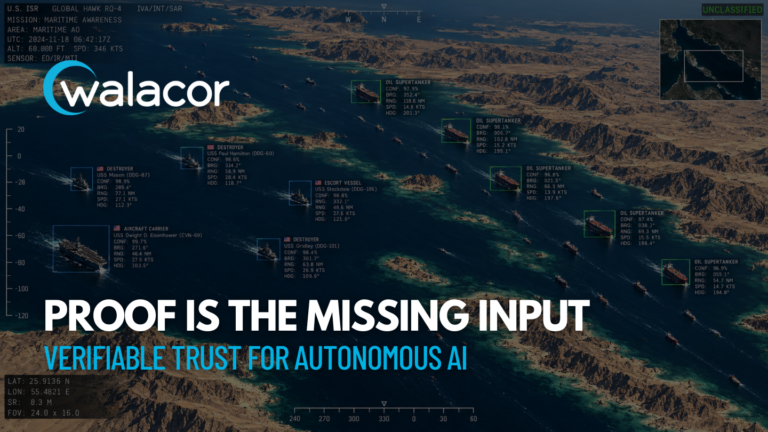
A high-altitude reconnaissance aircraft observes a maritime operating area. AI systems classify vessels, correlate intelligence, assess potential threats, and generate recommendations. Autonomous agents update a shared operational picture and coordinate subsequent activities. The entire sequence can unfold in seconds.
But what happens when a sensor feed has been manipulated, an intelligence record altered, or an autonomous agent acts on information whose integrity cannot be established? A single compromised input can propagate through automated workflows, influencing decisions involving military assets, critical infrastructure, and human lives.
Traditional cybersecurity establishes whether systems and users are authorized to operate. It does not necessarily establish whether the information those systems consume has retained its integrity.
As AI increasingly shapes operational decisions at machine speed, cryptographically verifiable data integrity and provenance become mission-critical requirements.
The Expanding Chain of Military AI Operations
Modern defense operations depend on interconnected intelligence, surveillance, reconnaissance, command-and-control, and autonomous systems. Information moves between satellites, aircraft, tactical networks, intelligence databases, and operational platforms.
As sensor observations become intelligence products, intelligence products become AI inputs, and AI assessments inform operational decisions, each transformation introduces another dependency on the integrity of underlying information.
An AI agent may authenticate successfully, operate within its assigned permissions, and execute a legitimate workflow while relying on compromised information. The resulting activity can appear operationally valid even when its underlying data has been altered.
Maintaining trust requires verifiable evidence connecting source information, transformations, AI decisions, and subsequent actions, independent of the applications and infrastructure processing that information.
Establishing a Verifiable Foundation
Mission-critical AI requires four foundational capabilities:
- Cryptographic integrity provides mathematical evidence that recorded information has remained consistent with its established state, enabling unauthorized modifications to be detected.
- Immutable version history preserves previous states of operational information, allowing examination of records associated with historical decisions.
- Persistent provenance maintains recorded relationships between information sources, transformations, derived products, and subsequent activities.
- Independent verification allows authorized systems and personnel to validate information against protected integrity evidence without relying exclusively on the applications or databases presenting it.
For autonomous systems, this evidence must extend beyond source data to include AI inputs and outputs, model versions, recorded authorizations, and resulting operational actions.
The objective is not to prove that every observation or AI assessment is correct, but to establish verifiable evidence of what information was used, how it changed, and which decisions depended upon it.
Walacor: The Software Node of Trust for Mission-Critical AI
Walacor provides a secure data platform designed to establish persistent, cryptographically verifiable integrity across mission-critical information. Its architecture combines encrypted data storage, blockchain-backed integrity records, immutable version history, and comprehensive auditability.
Operating as a software node of trust, Walacor establishes cryptographic evidence when information is recorded, preserving a verifiable relationship between the data, its historical states, and associated provenance. This allows authorized systems to detect alterations and validate information independently of the applications or databases presenting it.
Walacor supports cloud, on-premises, hybrid, and edge environments, integrating with existing mission systems to protect intelligence records, sensor observations, model artifacts, and operational evidence.
By preserving relationships between source information, AI processing, and operational outcomes, Walacor supports independent validation, investigation, mission assurance, and command accountability across distributed and contested environments.
Proof Becomes a Mission Requirement
As AI agents assume greater operational responsibilities, evidence must scale with the speed and complexity of military operations. Verification must become an integral part of how information is consumed, processed, and acted upon, rather than an activity performed only after an incident.
Walacor provides the cryptographically verifiable data integrity, immutable history, and provenance foundation needed to support trust and accountability across mission-critical AI operations.
Proof is no longer just an audit requirement. It is an operational input. Explore how Walacor can strengthen data integrity, AI assurance, and operational accountability across defense and national security environments. Visit walacor.com to inquire.