Establishing Integrity at the Point of Entry
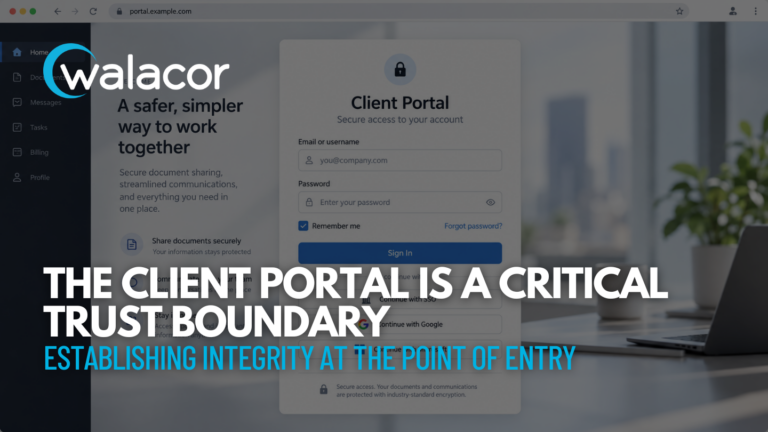
A client portal looks simple from the outside. A customer uploads a document, submits an instruction, approves a transaction, opens a case, shares a record, or communicates with an organization. Behind that interaction is a critical trust boundary. The information entering through these portals rarely stays there. It moves into enterprise systems, document repositories, financial platforms, AI models, workflow engines, security systems, operational applications, and automated processes. One external submission can become the source for dozens of subsequent actions.
The portal is therefore one of the first places where external information becomes trusted enterprise data. For organizations holding highly sensitive or consequential information, establishing integrity at that boundary is increasingly important.
The Portal Concentrates High-Value Risk
Different industries use client portals for different purposes, but the underlying risk is similar. Enterprise systems may receive contracts, customer records, instructions, or configuration changes. Legal and financial organizations receive privileged or transaction-sensitive information. Healthcare, infrastructure, and defense environments may receive records that influence operational or mission decisions.
The same pattern appears across collaboration, DevSecOps, and security platforms. External information enters through a trusted interface, then moves into other systems where it may be processed, transformed, or acted upon.
That makes the portal boundary especially important. The information may be sensitive or consequential. It often moves across multiple systems, passes through privileged identities and integrations, and increasingly becomes input to AI and automated workflows. The highest-value environments are the ones where several of those conditions overlap.
A Valid Login Does Not Establish Data Integrity
Modern platforms provide sophisticated authentication, authorization, encryption, monitoring, and access controls. Those capabilities govern who and what can interact with information. The record itself also needs an established state.
A stolen credential, compromised administrator, trusted integration, or service account can all operate through valid pathways. The surrounding systems may process those actions normally even when the underlying data has been changed.
That change can affect a payment instruction, customer record, configuration, clinical document, software artifact, or mission-critical input. Once the altered information becomes accepted as the current state, every downstream system may inherit it.
This creates an important requirement at the trust boundary. The organization needs a reliable way to establish what entered, when it entered, who or what supplied it, and how it changed afterward.
AI Multiplies the Consequences
The value of provenance increases as AI becomes part of enterprise workflows. A document uploaded through a portal may become an AI summary, extraction, recommendation, risk assessment, draft, classification, or automated action. A support request may initiate an agentic workflow. A financial instruction may enter fraud analysis. A clinical record may influence decision support. Mission data may become input to analytical or autonomous systems.
A compromised source can become an AI-poisoning pathway. The AI system may operate exactly as designed while working from manipulated information. The resulting output can move into additional systems and influence subsequent decisions at machine speed.
Establishing provenance when the information first enters the environment gives the organization a reference point for everything that follows. An AI-generated result can identify the precise records and versions that informed it. An automated workflow can reference the instruction that triggered it. An agentic action can carry the provenance of the information on which the action depended.
The portal becomes the beginning of a verifiable chain from source to decision to action.
Integrity Should Begin at Entry
A consequential record can receive a durable identity and cryptographic integrity proof when it first arrives. A client uploads a document. The system establishes the state of that document as received. The upload event, source, time, record identity, and relevant context become associated with it. A later revision creates another attributable state while preserving the history of the earlier one.
The same principle applies beyond files. A customer instruction can become a verifiable record. An approval can become a verifiable event. A financial direction, configuration change, clinical submission, software artifact, or operational instruction can receive the same treatment.
That record identity can then follow the information as it moves. The CRM continues operating as the CRM. The document platform continues managing documents. The financial system processes transactions. The security platform analyzes events. AI systems perform analysis. Operational systems execute workflows. A common integrity and provenance layer preserves the trusted history connecting them.
Walacor Creates the Meta Layer
Walacor can provide that persistent layer beneath the applications organizations already use. Critical information entering through the portal receives a durable identity, cryptographic integrity, version history, and provenance. As that information moves between systems or produces derivative records, the relationships can remain attached to the underlying data lifecycle.
This creates a common trust layer across otherwise separate environments. A customer record in Salesforce can relate to a signed document in a content platform. That document can become an AI input. The AI output can trigger a ServiceNow workflow. A resulting action can create another enterprise record. Walacor can preserve the lineage connecting those events.
The same model applies to financial transactions, clinical records, software artifacts, security operations, and defense data. Every application naturally maintains its own history. Walacor can preserve continuity across the boundaries between those applications.
The organization gains the ability to establish what information originally entered, how it changed, what systems consumed it, what derived from it, and which decisions ultimately depended on it.
The Client Portal Is a Trust Boundary
Client portals sit where external parties and internal systems meet. External parties provide information through them, and internal systems begin relying on that information through them. That makes the portal one of the most valuable places to establish integrity and provenance.
For organizations managing concentrated secrets, consequential records, AI source data, multi-party custody, privileged infrastructure, or operational truth, the same principle applies. Establish trust when the data enters, preserve that trust as the data moves, and carry its provenance into AI, automation, and operational systems.
Walacor provides the meta layer that allows trust to follow the information from the client portal through every system that depends on it.