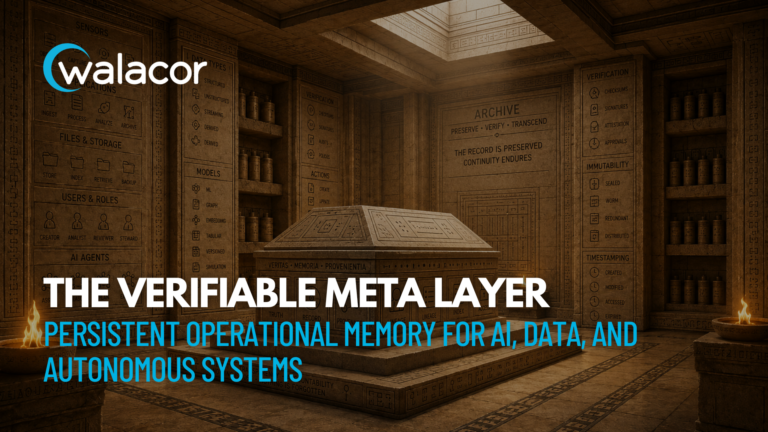
Persistent Operational Memory for AI, Data, and Autonomous Systems
Context Is What Makes Data Useful
Organizations generate vast amounts of data, but the data alone rarely explains what happened, why it happened, or whether the record can be trusted. The most valuable context often lies in the relationships surrounding it: where it came from, how it changed, which systems and policies governed it, who or what acted on it, and what outcome followed. Walacor creates and protects this persistent, verifiable history: “The Meta Layer”. Turning isolated records into operational memory that remains attributable, versioned, and independently verifiable.
This capability is increasingly critical as AI systems make decisions and take actions faster than people can oversee them. Walacor preserves evidence of the models, data, policies, tools, approvals, actions, and outcomes involved, while also providing the trusted provenance and historical context needed for analysis, anomaly detection, and long-term AI memory. Rather than replacing existing systems or storing everything, it selectively preserves the evidence needed to prove how data, decisions, systems, and outcomes relate across time.
More Than Metadata
The Meta Layer is broader than conventional metadata. Traditional metadata holds a filename, timestamp, owner, format, or database identifier—useful fields that rarely preserve the operational history of an object. Walacor preserves a much richer evidentiary structure around critical data: its origin and the system responsible for it, its configuration and full version history, its transformation and custody trail, the files, models, and decisions it touched, the approvals and exceptions applied to it, the model, prompt, input, and output relationships behind it, and the agent and tool activity and outcomes that followed.
Walacor’s architecture treats each submission as an immutable envelope and preserves prior states rather than overwriting them. A history structure provides a one-to-one record of submitted changes, while a summary structure represents the current state. Together, they create both a present-tense view and a persistent timeline from which lineage can be reconstructed. The result is verified operational memory.
What the Record Proves
Because this is an evidence layer, its boundaries matter. Walacor makes a record permanent, attributable, and independently verifiable from the moment it is sealed. It proves that the record has not been altered, that its version history remains intact, that its provenance can be examined, and that someone can verify it without trusting the system that produced it. That is a strong and unusual proof, and it is the foundation on which everything else rests.
Walacor does not, by itself, determine whether a source system reported the truth before capture. The closer the seal is placed to the point of execution, the smaller the gap in which an unrecorded or altered event can hide. Walacor’s value grows as capture moves closer to that point of execution, where events can be recorded completely, rather than reconstructed later from systems that may have already moved on.
The distinction matters because it is the distinction a regulator, auditor, investigator, or court will draw. “We believe the system did X” is materially different from “Here is a sealed, attributable record showing that the system did X, and you can independently verify it.”
Value Compounds Over Time
A data point has limited value without context. A temperature reading becomes meaningful when linked to the sensor, its calibration history, operating conditions, and the outcome that followed. Likewise, an AI output gains value when connected to the model version, prompt, source data, policy, tools, approvals, and resulting action.
The Meta Layer preserves these relationships over time. As verified events accumulate, they reveal patterns, degradation, anomalies, and recurring behaviors creating a durable record of how an organization, asset, or AI system operates, beyond the lifespan of any single application, vendor, administrator, or model.
State Is Useful. State Transition Is the Signal.
Most enterprise systems are optimized to report the current configuration, latest customer record, current model, current equipment status, or current operational picture. Yet how a state was reached often carries more information than the state itself.
A machine may appear healthy while its verified maintenance and telemetry history shows a sequence that preceded failure three times before. A financial account may look normal while its custody, access, and transaction sequence resembles a known fraud pattern. A model may pass its current evaluation while its training-data lineage and configuration history show progressive drift. A mission feed may appear valid while changes in its source, timing, routing, and sensor behavior indicate manipulation.
The primary record says what is. The Meta Layer explains how it came to be.
That reframes what an organization’s most valuable AI data may actually be. The most valuable data for long-timescale AI may not be the individual records an organization produces, but the verified history of how those records were created, changed, connected, used, and translated into outcomes.
The Meta Layer Is Valuable to AI
AI systems make thousands of decisions and actions faster than humans can oversee, often without a durable record of what they were asked, which policy applied, what tools they used, or whether they were authorized.
Walacor solves this evidence gap by creating sealed, attributable records of material AI behavior. Organizations can prove which model, data, policy, tools, and authority produced an outcome without relying on editable logs or fragmented systems.
The Meta Layer also improves AI quality by preserving provenance, linking outcomes to the exact conditions that produced them, and enabling drift and anomaly detection against a verifiable history.
The Meta Layer as AI Memory
Modern AI systems increasingly require long-term persistent memory.
Ordinary application memory is usually fragmented, editable, vendor-specific, and dependent on the continued operation of the system that created it. Walacor provides a separate, persistent memory layer whose records carry integrity, lineage, version history, and audit evidence. That makes the Meta Layer valuable as both evidentiary memory and analytical memory.
The evidentiary role is available today and is the reason the analytical role can be trusted. Analysis performed on an editable, fragmented history is only as reliable as that history. Analysis performed on a verifiable history can be examined, reproduced, challenged, and defended.
Practical by Design
A reasonable objection to any “record everything” vision is cost and scale. Capturing every token, trace, metric, and transient event would be unnecessary and unaffordable.
Walacor instead uses a tiered model. High-consequence events such as deployments, approvals, policy changes, material decisions, overrides, and security exceptions are captured every time. Lower-risk telemetry can be batched or summarized with integrity-protected checkpoints, while large files and model weights can be registered by reference and cryptographic identity.
The goal is not to store everything, but to preserve the evidence needed to prove the lifecycle complete where it matters, practical everywhere else.
Alongside Existing Systems
Walacor does not replace the systems that already perform useful work. A database holds transactions. An object store holds files. A SIEM holds alerts. An MLOps platform manages models. An agent platform manages execution traces. Those tools manage operational lifecycle mechanics. Walacor preserves the evidentiary chain across them without requiring any one platform to become the permanent authority for its own history.
Operational tools are optimized to run the organization now. Walacor is optimized to preserve a verifiable account of what the organization did so that the account survives when the tools around it change.
From Data Lake to Evidence Graph
A data lake collects information. A Meta Layer establishes the relationships among that information. Over time, records preserved by Walacor can form the foundation of an evidence graph connecting Source → Data → Transformation → Model → Decision → Action → Outcome.
Each connection adds value. An organization can examine which sources reliably produce useful results, which transformations introduce errors, which model versions perform best under particular conditions, which decisions lead to successful outcomes, and which sequences precede failure or compromise. The Meta Layer becomes the common, verifiable substrate for understanding how objects in otherwise separate systems actually relate.
Who Owns the Operational Memory?
This is where the concept moves from architecture to executive urgency. Organizations that preserve the Meta Layer retain ownership of their operational memory; those that leave it fragmented across vendors, logs, applications, and transient AI platforms surrender one of the most valuable datasets they will ever create.
As AI systems grow more capable, models and applications will change rapidly—and increasingly become interchangeable. What endures is the verified record of what those systems consumed, produced, changed, approved, rejected, and caused: one of an organization’s most valuable and defensible assets. Models can be replaced, applications migrated, infrastructure rebuilt; the accumulated, verifiable history cannot be recreated once it has been lost.
Walacor protects that history and makes it provable. It is the Verifiable Meta Layer: the persistent operational memory that proves how data, decisions, systems, and outcomes relate across time, allowing organizations and AI systems to establish what happened, why it happened, what changed, and, above all, what can be trusted.
Get Started with Walacor
Developers can begin working with Walacor through the open-source tools available on GitHub, including Python, TypeScript, and .NET SDKs, a command-line tool, an object and file integrity validator, data-science tracking tools, and public-chain anchoring components. Explore the repositories, build with the platform, and join the Walacor community on Discord to connect with the team, discuss implementations, and help shape the future of the Verifiable Meta Layer. Builders can also deploy Walacor directly through the AWS Marketplace or the Microsoft Azure Marketplace.