Lessons from the 2026 Infrastructure Disruptions
Modern asymmetric warfare increasingly targets the critical infrastructure that sustains America’s economy, military readiness, and essential services. Water treatment facilities, transportation networks, industrial manufacturing, financial institutions, and military logistics depend on interconnected digital systems. Disrupting these systems can generate significant physical, economic, and societal consequences through relatively limited interventions.
A series of incidents throughout 2026 illustrates this evolving threat and the growing importance of protecting operational data, system configurations, financial transactions, and the authority governing critical infrastructure.
When Cyberattacks Become Physical Disruptions
In April 2026, the FBI, CISA, NSA, EPA, and other federal agencies warned that Iranian-affiliated cyber actors were targeting programmable logic controllers (PLCs) across American critical infrastructure. Investigators documented manipulation of industrial control information and operational disruptions affecting essential services.
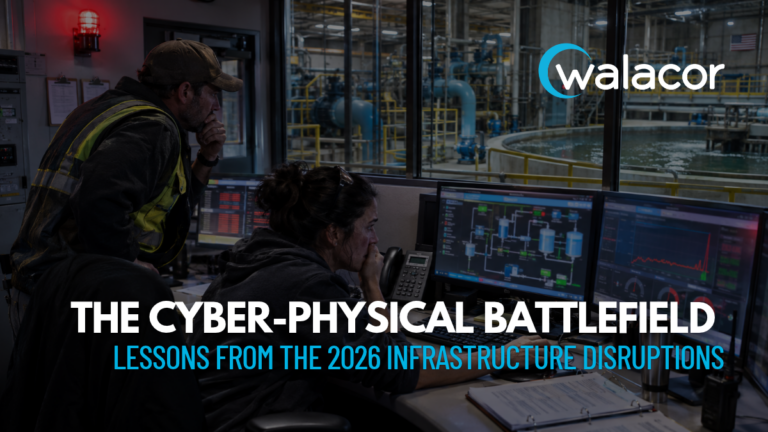
By July, coordinated cyberattacks had targeted more than 30 community water systems in Minnesota. Some facilities required manual operations, while one community temporarily lost automated control of its water treatment infrastructure.
The Pentagon also investigated suspicious refrigeration failures at multiple American military commissaries, raising concerns about digital controls supporting military food storage and logistics.
A major Microsoft service disruption also highlighted another critical dependency. Organizations rely on Microsoft’s identity, authentication, communications, and cloud services to access and operate essential systems. Outages affecting these services can prevent personnel from accessing industrial controls, coordinating emergency responses, managing logistics, and maintaining physical operations.
A telecommunications disruption triggered a nationwide FAA ground stop, demonstrating how failures within interconnected systems can affect critical operations across the country. Investigators identified destabilizing network traffic associated with a limited number of locations, highlighting the strategic significance of configuration integrity and shared infrastructure dependencies.
Customers of JPMorgan Chase and other major American banks reported disruptions to online banking and financial services. These incidents bring another critical dependency into focus: access to money enables the purchase of food, fuel, medicine, transportation, and other necessities. A sustained interruption to banking and payment services can cascade into supply chains, business operations, and public safety. Even when the initial disruption is confined to digital services, its consequences can extend throughout the physical economy.
Together, these incidents illustrate how disruptions to essential digital systems can produce consequences far beyond their immediate technical environments. They also demonstrate why critical infrastructure is an increasingly important dimension of asymmetric warfare.
How Walacor Protects the Integrity of Critical Systems
Critical infrastructure operates through configurations, software, sensor readings, administrative commands, transaction records, and operational data. The integrity of this information directly influences equipment behavior, financial activity, operational decisions, and recovery.
Walacor provides Provable Integrity through cryptographically protected data records, detectable immutability, persistent version histories, and independently verifiable integrity evidence.
When an approved configuration, software artifact, transaction record, or operational dataset is submitted to Walacor, the platform encrypts the data and records a cryptographic hash through its blockchain-backed integrity architecture. The protected information becomes part of a permanent, verifiable history. Subsequent updates preserve earlier versions, establishing an auditable record of changes.
Consider a water treatment facility whose programmable logic controllers govern pumping operations, chemical treatment, and water distribution. Approved controller configurations can be registered through Walacor as trusted operational references. If a compromised administrator or remote attacker subsequently alters those configurations, an integrated monitoring system can compare the current configuration against the cryptographically protected reference.
Walacor provides verifiable evidence to establish whether critical operating information has changed and whether it matches an approved state.
The same principles apply to financial systems. Transaction records, authorization histories, system configurations, and operational changes can be preserved with cryptographic integrity and attributable version histories. These capabilities help financial institutions validate critical information, investigate unauthorized modifications, and establish trustworthy records during restoration.
Walacor’s immutable histories also support incident reconstruction. Organizations can preserve configuration versions, operational telemetry, administrative changes, and associated authorization records, creating persistent evidence of what occurred and when. Its controlled data-sharing capabilities support the exchange of protected evidence among infrastructure operators, investigators, and authorized government organizations.
Provable Integrity for Recovery and Accountable AI
Following a cyber-physical attack, restoring operations requires more than recovering systems and data. Recovery teams must establish confidence in the configurations, software, transaction records, and operational information used to bring critical infrastructure back online.
Walacor contributes to this process by preserving cryptographically verifiable records of previously established operating states. These records provide independent reference points for validating restored configurations and critical information, helping recovery teams identify unauthorized changes and determine whether recovered data matches its recorded state.
As artificial intelligence assumes a greater role in infrastructure management, maintaining verifiable operational evidence becomes equally important. AI systems increasingly interpret sensor data, administer infrastructure, process transactions, recommend operational changes, and execute instructions affecting physical equipment.
Walacor provides an integrity and provenance foundation for preserving evidence of the information AI systems consume, the authority under which they operate, their recorded decisions, and resulting actions. When integrated with existing authorization, monitoring, and operational controls, this evidence supports independent verification, forensic analysis, and accountability across automated operations.
Walacor does not replace cybersecurity, recovery, or AI governance systems. It strengthens these capabilities by making the underlying operational records independently verifiable, even when the systems that produced or maintained them may no longer be trusted.
National Resilience Begins with Provable Integrity
The 2026 infrastructure incidents demonstrate the interconnected nature of America’s essential systems and the strategic consequences of disrupting them. Asymmetric warfare exploits these dependencies, making trustworthy operational information an increasingly important element of national defense.
Strengthening national resilience requires coordinated cybersecurity, operational continuity, recovery capabilities, and accountable automation. Underlying these efforts is a fundamental requirement: the ability to establish whether critical information has been altered and to independently verify the evidence used to make operational decisions.
Walacor addresses this requirement through cryptographic integrity and provenance, enabling organizations to detect alterations to protected records, reconstruct recorded operational changes, and validate critical information against previously established references.
Walacor delivers Provable Integrity as a foundational capability for mission-critical infrastructure, providing independently verifiable evidence that strengthens cyber resilience, supports accountable AI operations, and increases confidence in recovery decisions.