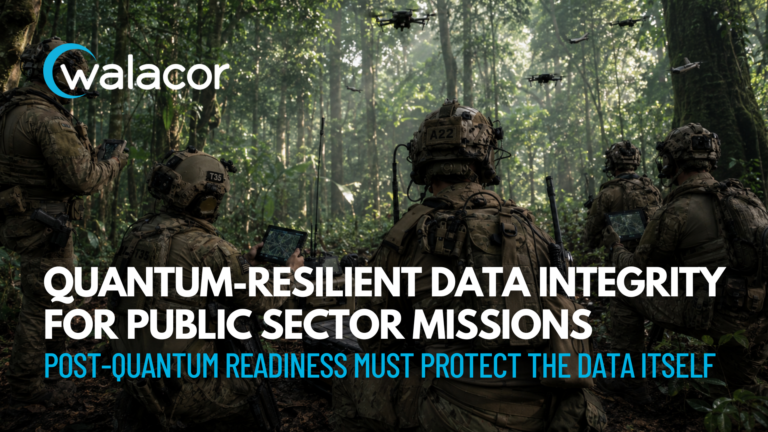
Post-Quantum Readiness Must Protect the Data Itself
The public sector is entering a new phase of cybersecurity modernization. Quantum computing is no longer treated as a distant research topic. It is now a strategic planning issue for agencies, defense organizations, system integrators, and mission owners responsible for protecting sensitive information over long operational lifecycles.
The federal transition to post-quantum cryptography is already underway. Agencies are being asked to identify vulnerable cryptographic systems, prioritize high-value assets, and prepare for a future where today’s widely deployed public-key cryptography may no longer provide adequate protection. This shift is especially important for long-lived public-sector data, including intelligence records, health data, financial records, infrastructure data, legal evidence, mission logs, supply-chain data, and AI training datasets.
The practical question for public-sector leaders is no longer whether quantum risk matters. The question is how to build systems that remain trustworthy as cryptographic standards, mission architectures, and threat models continue to evolve.
Quantum Risk Extends Beyond Encryption
Encryption is central to post-quantum readiness, but not all cryptographic risk is the same. The most urgent quantum migration concern is not data encryption itself. The larger concern is the public-key infrastructure used to establish, exchange, authenticate, and manage keys.
Widely deployed public-key systems such as RSA, Diffie-Hellman, and elliptic-curve cryptography depend on mathematical assumptions that are vulnerable to sufficiently capable quantum computers. That matters for key exchange, digital signatures, certificates, software signing, secure communications, cloud services, and mission systems. If the mechanism used to establish or authenticate a key is vulnerable, then the data protected by that key may be at risk even if the underlying symmetric encryption remains strong.
Symmetric encryption is a different problem. When AES-256 is implemented correctly and the key is protected, the practical quantum concern is not that an adversary directly decrypts the ciphertext. The more important risk is how the key is created, exchanged, stored, wrapped, rotated, accessed, and governed. For public-sector agencies, post-quantum readiness therefore requires more than choosing strong encryption. It requires controlling the full key lifecycle and preserving trust in the data protected by those keys.
Yet even a sound cryptographic migration does not solve the full mission problem.
Public-sector trust also depends on the integrity of the data being protected. A strongly encrypted record still creates mission risk if the record was corrupted before it was encrypted. A quantum-resistant communications channel still creates operational risk if the data moving through it has been poisoned, manipulated, duplicated, silently altered, or stripped of provenance. An AI system may operate inside a modernized security environment and still produce unreliable outputs if its training data, prompts, model files, inference inputs, or audit logs cannot be verified.
This is why post-quantum readiness should be treated as a data lifecycle problem. Agencies need systems that preserve confidentiality, integrity, authenticity, provenance, and auditability from the moment data becomes a record of truth.
The Public-Sector Data Lifecycle Is Expanding
Mission data is no longer confined to a single database, application, network, or enclave. Public-sector data now moves across cloud, on-premises, hybrid, edge, tactical, coalition, and disconnected environments. It may pass through sensors, APIs, data lakes, object stores, analytics pipelines, AI models, DevSecOps tools, and partner systems before it informs a decision.
That expansion creates new governance requirements.
Agencies need to know where data came from, which version is authoritative, who changed it, whether it was altered, how it was shared, which systems processed it, and whether it can be trusted at the point of use. These questions become more important as AI and autonomous systems operate at machine speed and as public-sector missions rely on data that may need to remain secure and evidentiary for years or decades.
Quantum-resilient security therefore requires more than algorithm migration. It requires a data layer that can travel with the mission. That layer should protect individual records, files, objects, events, and evidence artifacts with persistent integrity controls rather than relying only on the security posture of the surrounding infrastructure.
Walacor’s Role in Quantum-Resilient Data Integrity
Walacor provides a secure data platform designed to make data integrity verifiable. The platform protects data with per-item encryption keys, detectable immutability, full auditability, and cryptographic provenance across structured and unstructured data environments.
This architecture is important in a post-quantum context because long-lived mission data must remain verifiable even as agencies modernize key exchange, signing, PKI, authentication, and secure transport. The migration problem is not only about replacing vulnerable public-key algorithms. Agencies also need to preserve confidence in the data itself, including its integrity, provenance, version history, chain of custody, and evidentiary value.
Instead of treating data security as a feature added after storage, Walacor embeds trust into the data lifecycle. Each record, file, object, or data element can be protected as an individually verifiable asset. Data changes create attributable versions. Audit trails are preserved. Unauthorized alteration becomes detectable. Provenance can be reviewed by operators, administrators, auditors, cyber teams, mission owners, and automated systems.
For public-sector organizations preparing for post-quantum requirements, this matters because quantum resilience must preserve both confidentiality and trust. Agencies need to know that sensitive data remains protected as key exchange, key management, signing, and authentication mechanisms evolve, while the data itself remains authentic, intact, and auditable over time.
Walacor strengthens that posture by operating as a secure data layer across cloud, on-premises, hybrid, and edge environments. It can sit alongside existing databases, applications, object stores, analytics platforms, and AI pipelines, allowing agencies and integrators to add data integrity capabilities without replacing every system in the stack.
This Matters for AI and Autonomous Systems
Quantum modernization and AI modernization are converging. Public-sector agencies are rapidly adopting AI-assisted analytics, autonomous workflows, digital twins, sensor fusion, decision-support tools, and agentic systems. These systems depend on trusted data.
If adversaries can poison training data, alter operational telemetry, manipulate model files, corrupt inference inputs, or tamper with logs, AI governance becomes difficult to enforce. Policy alone cannot prove that a dataset is authentic. Process alone cannot prove that a model artifact has not been modified. Traditional logs may be incomplete, fragmented, or dependent on systems that were compromised during an incident.
Walacor gives AI and mission systems a stronger foundation by preserving cryptographic evidence throughout the data lifecycle. Training datasets, model versions, evaluation results, approvals, inference records, sensor data, and operational logs can be stored with verifiable integrity and auditability. This allows agencies to reconstruct what happened, verify which data was used, and establish whether a decision was based on trusted information.
As agencies modernize for quantum risk, they also have an opportunity to modernize the trust model beneath AI.
Use Cases for Public-Sector Quantum Resilience
Walacor’s secure data layer is especially relevant for public-sector use cases involving long-lived, high-value, or mission-critical data.
- Defense and intelligence missions can use verifiable data integrity for ISR data, mission logs, targeting support, digital evidence, coalition sharing, and AI-enabled analysis.
- Civilian agencies can strengthen the protection of health records, benefit systems, investigative records, infrastructure data, regulatory evidence, and sensitive citizen data.
- DevSecOps and software assurance teams can preserve SBOMs, build artifacts, security scans, approvals, configuration histories, and software-signing evidence in tamper-evident form.
- AI governance teams can establish verifiable lineage for datasets, models, prompts, inference events, and decision records.
- Critical infrastructure operators can protect operational technology data, telemetry, incident evidence, digital twin inputs, and recovery baselines from unauthorized alteration.
In each case, the objective is the same: preserve data as a trustworthy asset across its lifecycle.
From Cryptographic Migration to Mission Assurance
Post-quantum migration is often discussed as an algorithm transition. That framing is important, especially for public-key systems used in key exchange, digital signatures, PKI, software signing, and authentication. But it is incomplete for mission environments where data must remain trustworthy long after it is created.
Public-sector organizations need a clear plan for vulnerable public-key dependencies. They also need data provenance, immutable audit trails, chain of custody, secure sharing, and rapid verification. They need to prove that critical data is authentic before it is analyzed, shared, processed by AI, used in an operational decision, or restored after an incident.
Walacor helps agencies and system integrators close that gap by providing a secure data layer built for persistent integrity, per-item protection, verifiable provenance, and public-sector mission assurance.
The quantum era will require stronger cryptographic migration planning. It will also require stronger proof. Walacor delivers the data-layer trust foundation agencies need to protect information, preserve confidence, and operate securely in a changing threat environment.