Integrity-First Requires A New Developer Model
For decades, application development has been shaped by the way databases operate. Most traditional application data models are organized around a familiar set of operations: creating new records, reading existing ones, updating stored data, and deleting entries. These actions are useful, intuitive, and deeply embedded in modern software development. They shaped API design, application logic, user interfaces, frameworks, admin tools, and developer expectations.
That familiarity matters. Developers need systems they can understand quickly. Enterprises need platforms that can be adopted without forcing every team to abandon their existing mental model. CRUD became so durable because it maps naturally to how many applications work: create a customer, read an order, update a status, delete a draft, retrieve a list, modify a field, or remove something from an active workflow.
Walacor respects that reality. Even though The Platform uses emerging technologies, like blockchain, it exposes a CRUD based REST API which allows developers to interact with data in ways that feel familiar. Developers can create schemas, submit records, query data, update records, manage users, assign roles, upload files, and build ordinary application workflows. In that sense, Walacor behaves in a way developers can recognize. It is intentionally designed with a database look and feel so adoption can be practical.
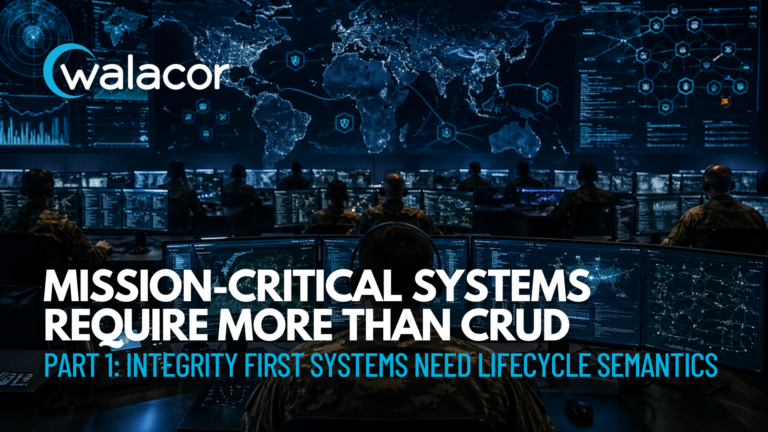
The important point is that mission-critical systems require more than the basic CRUD mental model alone. The familiar operations still exist, but they are surrounded by stronger semantics. A record is also part of a lifecycle. An update is also an event. A schema is also a historical context. A file is also a governed object. A query may need to distinguish the current state from history. A data-sharing action may need explicit organizational approval and accountability. A write operation may need to become part of a cryptographically verifiable record.
Modern systems operate across clouds, APIs, AI pipelines, edge devices, partners, analytics systems, and automated workflows. Decisions are made faster. Systems interact more often. Artificial intelligence agents can generate, transform, and act on data at machine speed. In these environments, developers need to know where data came from, whether it changed, who or what changed it, which version was used, what system touched it, which schema governed it, and whether the information being used today can be tied back to the record that was created earlier.
CRUD Is Useful, but Mission-Critical Systems Need Lifecycle Semantics
CRUD remains useful because applications still need to create, read, update, and manage data. A developer building on Walacor can still think in terms of records, schemas, APIs, queries, files, users, and workflows. The difference is that Walacor adds integrity semantics beneath those interactions.
In an ordinary application:
A create operation may simply insert a new row or document. In Walacor, a submission enters an envelope-based workflow. The data is routed by ETId, processed through the platform, encrypted, associated with platform metadata, and preserved as part of an immutable record of activity. The developer still has a practical API surface, while the platform adds assurance beneath the surface.
A read operation may return the current value of a record. In Walacor, developers can think more precisely about whether they need the current operational view or the historical record. A summary view can support performance and day-to-day workflows. A history view can support reconstruction, audit, compliance, AI governance, and forensic analysis.
An update may be treated as a replacement of state. In Walacor, an update contributes to the lifecycle of a record. The record can evolve while the platform preserves the history of that evolution. This matters because an organization may later need to know when a change occurred, what the prior value was, which user or process caused it, and which downstream decision used which version.
Deletion often means removal from the active data store. In an integrity-first system, deletion carries governance significance. Applications can still support lifecycle states, user-facing removal, inactive records, deletion markers, and ordinary workflow behavior. The underlying system preserves the record history so the organization can understand what occurred later.
This is the more accurate way to frame the shift: CRUD provides the interaction vocabulary, while Walacor adds the lifecycle and proof model required for mission-critical systems. That is the shift Walacor is built for. It gives developers a secure data platform where data is handled as an integrity-bearing asset from the moment it enters the system. It preserves familiar application patterns while introducing operating semantics for cryptographic assurance, persistent history, schema versioning, auditability, and controlled data sharing.
At a practical level, developers building with Walacor should think in terms of several core concepts:
- ETIds as routing identities for governed data structures.
- Envelopes as structured submissions into an integrity workflow.
- Schema versions as preserved context for how data was defined over time.
- Summary and history views as distinct ways to understand current state and record lifecycle.
- Audit history as first-class data.
- File verification as a deliberate step before permanent storage.
- Sharing contracts as structured, approval-based mechanisms for data exchange.
Next Up → Part 2: ETIds, Envelopes, and History: The Developer Primitives of Walacor
In Part 2, we will move from the conceptual shift to the developer primitives that make this model practical: ETIds, envelopes, schema versions, file verification, summary views, history views, and sharing contracts.