Proof as an Operational Requirement
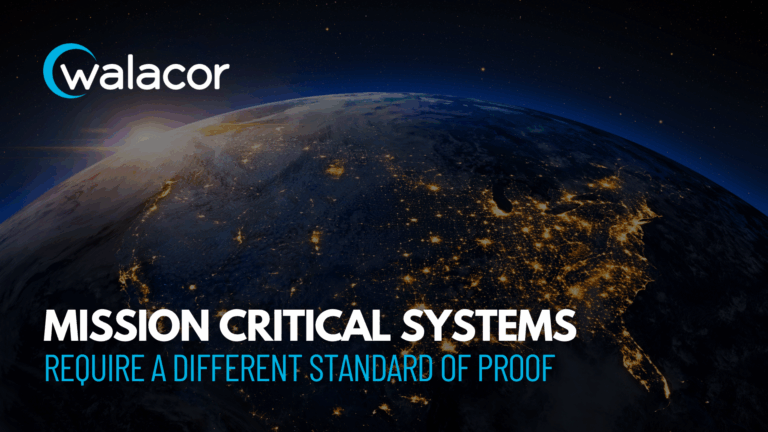
Mission critical systems operate under an evidentiary standard that is increasingly relevant across complex operating environments as decision-making becomes more distributed, automated, and long-lived. Actions must remain verifiable across distributed operations, rotating authority, long time horizons, and evolving technical infrastructure. Verification must persist independent of personnel continuity, system topology, or later interpretation.
Walacor is built for environments where legitimacy must be demonstrable through execution itself, national security, financial infrastructure, hospitals and heatlhcare, emergency services, supply chain and energy infrastructure. Proof is produced as a byproduct of governed operation, and will record each consequential action within a structured, versioned context that preserves meaning over time.
Contested Environments and Legitimacy
In national security contexts, proof is inseparable from legitimacy, a condition that increasingly applies wherever decisions are subject to regulatory, legal, or third-party scrutiny. Systems are expected to demonstrate that actions were taken intentionally, under defined authority, within applicable constraints, and using information that was valid at the time of execution.
Adversarial environments increase scrutiny rather than reduce it. Inputs may be challenged, attribution questioned, and intent reinterpreted by external parties operating under different incentives and authorities. In these conditions, legitimacy must rest on records that are self-describing and independently verifiable, rather than dependent on narrative reconstruction.
Walacor records actions in a form that preserves evidentiary standing without requiring explanation by operators or maintainers.
Authority and Access as Distinct System Properties
Complex operational systems frequently conflate access with authority. Credentials and permissions indicate who could act within a system, but they do not, by themselves, establish whether an action was authorized under the specific rules, delegations, and scopes in force at the time.
Walacor will preserve authority as part of execution context, with actions recorded alongside the roles, delegations, approvals, and constraints that governed them, using structured representations that remain interpretable as organizational structures and policies evolve.
This separation allows authority to remain traceable even when responsibilities rotate, powers are delegated, or organizational boundaries change.
Time and Long-Horizon Verification
Mission critical decisions are often reviewed long after they are made. Oversight, compliance, legal review, and historical accountability introduce audiences separated from execution by months or years.
Walacor designs for verification across time by preserving primary execution records within an append-only provenance layer. These records remain interpretable through explicit versioning of schemas, rules, and contextual definitions, allowing past actions to be evaluated according to the standards that applied when they occurred.
Verification does not depend on retained logs, institutional memory, or stable system implementations. Meaning is preserved as part of the record itself.
Proof That Travels With Distributed Operations
Operational decisions span services, agencies, partners, contractors, and autonomous systems. At times, connectivity can be intermittent, trust boundaries can be fluid, and no single system can be assumed to act as a permanent authority of record.
Walacor treats each consequential action as independently verifiable wherever it is examined. Proof is local to execution but globally interpretable, carrying with it the structured context required to assess legitimacy without reliance on centralized services or organizational continuity.
This approach allows verification to occur across jurisdictional and technical boundaries without requiring shared infrastructure.
AI, Autonomy, and Evidentiary Continuity
As artificial intelligence and autonomous systems participate in operational decision-making, evidentiary requirements expand. Decisions are produced at scale, under constraints that may change over time, and with varying degrees of human involvement.
Walacor will preserve evidentiary continuity across human and machine actions by recording inputs, execution context, outputs, and subsequent effects within a unified provenance framework. Model versions, governing schemas, and applicable constraints remain bound to recorded actions.
This supports accountability without requiring access to internal reasoning processes or re-execution of historical systems.
Proof as a Strategic Capability
Proof functions as strategic infrastructure in systems where decisions must withstand audit, review, and challenge over time. It underpins credibility, alliance trust, operator protection, and long-term accountability.
Walacor treats proof as an intrinsic property of system operation, produced through governed execution and preserved through durable provenance. Verification is possible wherever and whenever actions are examined, based on records designed to retain meaning across time, systems, and organizational change.
This is the standard of proof required for mission critical systems operating in complex, distributed environments.