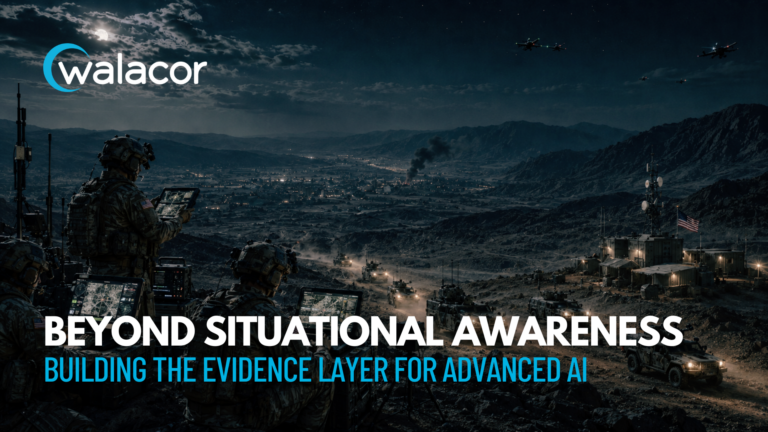
Building the Evidence Layer for Advanced AI
Artificial intelligence is advancing along several dimensions at once. Models are reasoning more capably. Agents are gaining memory, tools, context, and the ability to act across external systems. The infrastructure supporting them is expanding into data centers, energy systems, semiconductor supply chains, and national-security programs.
Leopold Aschenbrenner’s Situational Awareness: The Decade Ahead connects these developments into a strategic picture encompassing capability scaling, massive compute, laboratory security, alignment, autonomous systems, and geopolitical competition. Its timelines remain forecasts, and reasonable people dispute them. One question raised by the paper does not depend on any particular timeline:
What systems of trust must develop alongside more capable AI?
The answer requires powerful models, secure facilities, effective governance, and a provable evidence layer: a durable operational record supported by cryptographic proof of what ran, which data and policies governed it, what authority was recorded, what actions followed, and what changed.
Aschenbrenner’s analysis reinforces the urgent need for capabilities at the core of Walacor: cryptographically proven integrity, provenance, immutable history, and independently verifiable evidence for critical AI systems.
Capability Is Scaling Faster Than Accountability
Traditional software generally operates within bounded workflows. A user performs an action, an application executes predefined logic, and a database records the result. Responsibility may be distributed, but the path from instruction to execution is usually understandable.
AI agents create a more dynamic chain. An agent may receive a request, retrieve information from several sources, interpret policies, call external tools, delegate work to other models, modify records, communicate with third parties, or initiate an operational process. The resulting action may depend on the model and its version, active instructions, retrieved data, policy configurations, tool permissions, human approvals, and changes made by other systems during execution.
The records needed to reconstruct that action may be scattered across applications, databases, AI providers, gateways, identity systems, model platforms, and external tools. Some may be mutable. Others may omit intermediate actions, denied attempts, configuration changes, or the precise data available when a decision occurred.
An organization may know that an AI-generated action occurred while remaining unable to prove how it happened. That gap becomes more consequential as AI moves from generating content to affecting finance, infrastructure, healthcare, defense, manufacturing, cybersecurity, and autonomous operations.
The System Is More Than Its Weights
One of the central concerns in Situational Awareness is protecting frontier-model weights and algorithmic secrets from sophisticated adversaries. These assets are essential, but they represent only part of the operational surface that determines how an AI system behaves and whether its use can be trusted.
Training data, model checkpoints, evaluation results, deployment manifests, policy configurations, access records, approval decisions, infrastructure changes, tool executions, and operational outputs all influence the system. Access controls govern who can reach these assets. Encryption protects their confidentiality. Network and endpoint security protect the environments in which they operate.
A separate set of questions remains. Is an artifact intact? Which version is authoritative? Who changed it? Which version was used for a particular decision? Has the historical record itself been altered?
An attacker who cannot steal a model may still poison its data, alter an evaluation, substitute a configuration, manipulate a deployment record, or corrupt the evidence later used to investigate an event. An insider may possess valid credentials while making an unauthorized change. An administrator may control both the operational system and the logs used to explain its behavior.
AI security therefore requires more than protected model weights. It requires provable integrity across the system’s operational history.
From Operational Records to Provable Evidence
A record becomes independently verifiable when an authorized party can confirm its integrity without relying exclusively on the application, vendor, or administrator responsible for the system being examined.
That capability rests on three properties:
- Content Integrity – binds a record to its exact contents through cryptographic proof, making later alteration detectable.
- Attributable History – preserves authorized changes as new versions rather than silently replacing prior state.
- Independent Witnessing – preserves the integrity record beyond the administrative boundary of the originating application, allowing another authorized party to verify it.
Together, these properties turn operational records into provable evidence. They allow an authorized party to verify that an artifact matches its registered state, that its version history remains intact, and that prior states have not been silently rewritten.
Precision matters. Cryptographic proof does not establish that an original assertion was factually correct. A sensor can generate an inaccurate reading. A person can submit false information. A compromised device can register manipulated data.
The evidence layer proves the integrity of the protected record and its history. Source authenticity, authority, and factual reliability still depend on identity, attestation, validation procedures, collection controls, signatures, and corroborating evidence.
A trustworthy architecture must preserve these distinctions. Was this the artifact originally registered? Who or what submitted it? Was the source authorized? Which version was used? What transformations occurred? Was the original information accurate? These questions are related, but they are not interchangeable.
Provable Evidence Beyond Explainability
Explainability asks why a model produced a particular output. Technical alignment asks whether the system follows intended objectives and constraints. A separate operational requirement asks whether the evidence surrounding the output can be independently verified.
When an AI system produces a harmful or unauthorized result, investigators may need to determine whether the model behaved unexpectedly, the system received corrupted data, an outdated configuration was active, a tool held excessive authority, an operator approved an exception, or an attacker altered an input or historical record.
Without provable evidence, these possibilities can collapse into competing claims. An evidence layer does not reveal every aspect of a model’s internal reasoning, but it can preserve proof of the observable operational lifecycle: what entered the system, which model and configuration were active, which policies applied, which tools were called, which approvals existed, what output was produced, what actions followed, and what changed.
The objective is more than making records available for inspection. It is ensuring that authorized parties can verify their integrity, provenance, version history, and chronology. That capability supports governance, security, audit, evaluation, procurement, insurance, litigation, and incident response.
Machine-Speed Systems Need Machine-Verifiable Trust
Human review remains essential for consequential decisions, but it cannot serve as the only control for systems operating across millions of requests, distributed agents, automated tools, and rapidly changing data. The evidence layer must operate at the speed of the systems it supports.
This does not require preserving every token, tensor, and operational metric. It requires selective capture of the records whose integrity is critical over time. Model and dataset versions, deployment approvals, policy changes, evaluation results, consequential tool calls, high-value decisions, human exceptions, and security events may warrant durable proof. High-volume, lower-risk telemetry may be batched, summarized, retained by reference, or placed in a different assurance tier.
A complete architecture can connect governance, execution, and evidence. A runtime control layer may verify that the approved model, policy, identity, data source, and tool authorization are active before a consequential action. Applications and gateways can then capture the relevant requests, decisions, data references, outputs, tool activity, warnings, and approvals.
The evidence layer preserves those records and creates cryptographic proof of their integrity, provenance, version history, and chronology. Runtime systems govern and observe execution. The evidence layer ensures that the resulting history remains provable afterward.
Why Existing Logs Are Not Always Enough
Organizations already use SIEMs, application logs, model registries, data catalogs, observability platforms, and audit systems. Each serves an important purpose. The issue is whether their integrity, completeness, custody, version history, and administrative independence are sufficient for the assurance requirement involved.
Application logs often remain within the same administrative environment as the systems they describe. Model registries and data catalogs organize models, datasets, metadata, and deployment state. Observability platforms help engineers troubleshoot runtime behavior. These records may contribute valuable evidence, but their strength depends on how they were generated, protected, authenticated, retained, and exported.
General-purpose ledgers can add immutability and timestamping, but enterprise and mission environments also require encryption, schema, controlled access, query ability, version semantics, and support for structured and unstructured information.
The evidence layer fills the space between these systems. It gives selected records distributed across applications, databases, object stores, pipelines, and AI workflows a persistent lifecycle with provable integrity and attributable history.
Walacor as the Provable Evidence Layer
Walacor provides a trust and mission-assurance layer for AI, autonomous systems, and critical data infrastructure. It preserves protected data, cryptographic integrity, immutable history, provenance, attributable versions, and auditability for critical records. An application can submit a record, file, artifact, or corresponding integrity record to Walacor as an envelope with a durable identity and version. Authorized changes create new versions while prior states remain part of the historical record. This allows an ordinary operational record to become part of a provable evidence chain.
Walacor can operate alongside existing databases, object stores, applications, data pipelines, AI platforms, model registries, gateways, and edge systems. Within an AI environment, it can preserve records associated with training data, model versions, evaluations, policy changes, configurations, operational inputs and outputs, approvals, security events, and custody history.
Walacor preserves the records supplied to it. Capturing runtime activity requires integration with the applications, agents, gateways, identity systems, policy engines, and tools operating in the execution path. When integrated with a runtime governance or gateway layer, the combined architecture can capture which model, provider, identity, policy, tool, and approval participated in an AI event. Walacor then provides cryptographic proof that the integrity and historical sequence of those records remain intact.
The Evidence Layer Is Strategic Infrastructure
The advanced-AI debate often focuses on who will build the most capable model, assemble the largest compute cluster, secure the most energy, or achieve the next algorithmic breakthrough. A second competition will emerge around trust.
Which organizations can prove that their models were properly evaluated? Which systems can establish that the approved model and policy were active when a decision occurred? Which institutions can reconstruct an AI incident without relying entirely on records controlled by the system under investigation? Which enterprises and nations can share critical AI artifacts while preserving provenance, custody, attribution, and integrity?
These capabilities influence security, adoption, regulation, procurement, insurance, litigation, mission readiness, and public confidence. Advanced AI produces more decisions and actions than humans can individually inspect. Durable governance will therefore depend on evidence that both people and machines can verify.
Situational awareness means recognizing the scale of the technological transition. Operational trust requires something further. It requires provable evidence of what ran, which data and policies governed it, what authority was exercised, what actions followed, and what changed.
Further Reading
This article is in response to infrastructure, security, and alignment themes raised in Leopold Aschenbrenner’s June 2024 paper, Situational Awareness: The Decade Ahead. Walacor is not affiliated with the author, and the views presented here are Walacor’s own analysis.